
IREM’S STORY
A threshold moment in New York that set this work in motion, a conversation about what it became, and the roots that preceded both.
I was 18 when I arrived in New York to study at Columbia. Living abroad for the first time, navigating a completely different city and culture. What I did not know then was that New York would be the beginning of a long detour from myself.
This is a personal interview, a conversation about who I am, where this work comes from, and why it matters so deeply to me. Everything here comes from my own life. I hope something in here speaks to yours.
Once I stopped mistaking my thoughts for myself, I could finally let go of the identity I had built around them.
That was the moment transformation stopped being theory and became personal for me.
What I love most about this work is seeing a person’s life change, and knowing that change does not end with them. It moves through everything they touch. That vision of change spreading outward is what makes this work a calling.
That asks something of me too. You cannot accompany someone along a path you have not walked yourself. So I keep working on myself, and I welcome that, because to be better at this work, I have to become a better human being.
Personal therapy is part of every psychotherapist’s training. We sit in the client’s chair before we sit in our own. One moment from those years has stayed with me.
"You're not looking at my eyes. It feels like you're speaking from your memory, not here."
That observation shifted something fundamental. I realized I wasn't exploring my experience, I was reciting it. Speaking from a script. A memorized, fixed way of describing myself to myself. And if I was reciting, I wasn't discovering. That is the difference between a fixed story and genuine inquiry. And it's where the work begins most of the time.
"Are you analyzing me right now?"
It makes me smile. Because my work actually asks me to do the opposite: to stop analyzing, and to simply be present. Without agenda. Without judgment. Without needing them to be different from how they are.
"Our choices create our reality, within the life we find ourselves in. Choose carefully."
The first choice, the one that shapes all others, is how we construct meaning from what we experience. How we meet this moment is a choice. And that choice creates our reality.
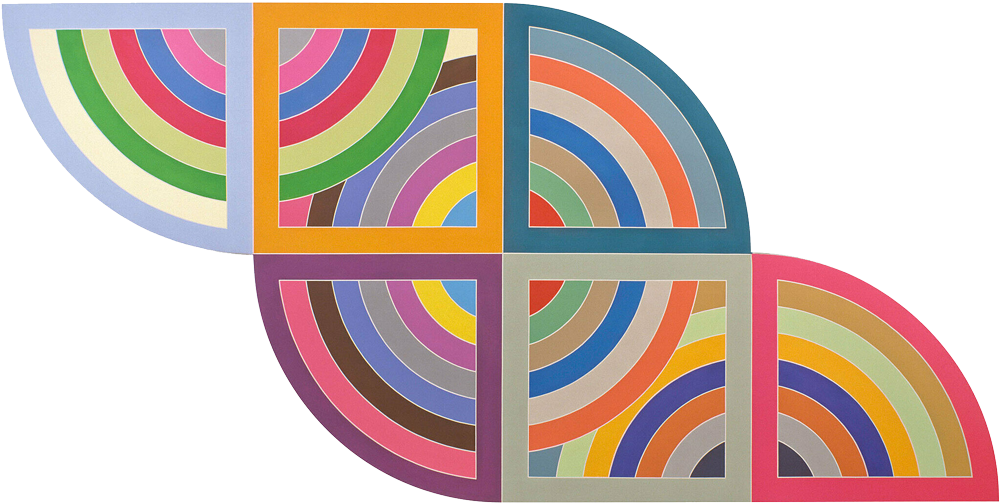
Frank Stella, Harran II, 1967
© Frank Stella / Artists Rights Society
Some stories begin long before we do. Mine starts in the final decades of an empire one that stretched across three continents and held within it cultures, languages, and peoples who would soon be scattered by the winds of history.
My father's family came from Crete, an island that was still Ottoman at the time, before the maps were redrawn and it became part of modern Greece. My mother's family came from Thessaloniki, today a Greek city, but then still part of the Ottoman Empire. When the old world dissolved, both families found themselves in a new one: Turkey. I was born in Istanbul. A city that has always been both a threshold and a crossroads: the place where continents meet, where ancient and modern coexist, where identity is never singular.
My roots taught me early that identity is never fixed, that borders move, and that belonging is something you carry within you.
My father attended a French high school, my mother a German one. They met at a university founded by Americans. In a single generation, my family had passed through French, German, and American intellectual traditions, a kind of cosmopolitan education that Istanbul, uniquely, made possible.
They began their careers together at an American consulting firm, two high achievers moving in parallel, building something side by side. But before I was born, my mother made a different kind of choice. She stepped away from that path deliberately and turned her full attention to raising my brother and me. That decision was never spoken of as sacrifice in our home. It was treated as her calling. She brought to it all of her rigor, determination, and devotion.
She raised us with intention, believing that character is built, and that a child raised that way grows up able to meet the world on their own terms.
My father kept going. Long hours at the consulting firm were not an exception; they were the rhythm of his days. I have few memories of weekday dinners with him. More often, he would arrive home just before we went to bed, or long after. His love for us was real, but it came in the margins of a schedule that left little room for himself or for what mattered most to him. The finances, the stability, the sheer responsibility of carrying the family, alone: these came first. Not because he chose ambition over us, but because he carried a deep, unspoken conviction that the greatest thing a father could give his family was safety.
In his world, responsibility and love were the same thing.
While I was in kindergarten, my family lived in the United States for a time. I found myself in an American classroom before I had a single word of English. My first words in English were: Can I go to the bathroom? Not out of any urgent need, but because I had quickly discovered it was the one reliable exit from naptime. Perhaps that was my first clue about myself.
Even then, I was looking for my own way out.
When we returned to Istanbul, I started elementary school in a state school class of seventy children under a teacher with a formidable academic reputation. That reputation was the reason my mother chose her.
What I remember from those years is something else entirely: a classroom that ran on dread, a teacher who believed that children could be shaped through intimidation and physical violence, and the particular terror of being a small person in a large room where something is wrong but no one says so.
In that silence, something else took hold: the beginning of a habit that would take years to unlearn. Not to feel, and not to name. To let what was present remain unspoken.
There was a prestigious and highly competitive high school, with entry determined by a single nationwide exam, that my mother had simply decided I would attend. I got in. Robert College: an institution older than the Turkish Republic itself, founded in 1863, when the Ottoman Empire still stood. It is the oldest continuously operating American school outside the United States. Its graduates include many of the people who shaped modern Turkey, from a Nobel laureate and prime ministers to leading figures in literature, the arts, science, and business.
It was there that I discovered philosophy and the arts.
Even as a teenager, I knew what I was drawn to: ideas, people, the endless diversity of ways a life could be lived. I needed a place that could hold all of that. A city of multitudes. A university that rewarded questioning over certainty.
Columbia felt less like a choice and more like gravity.
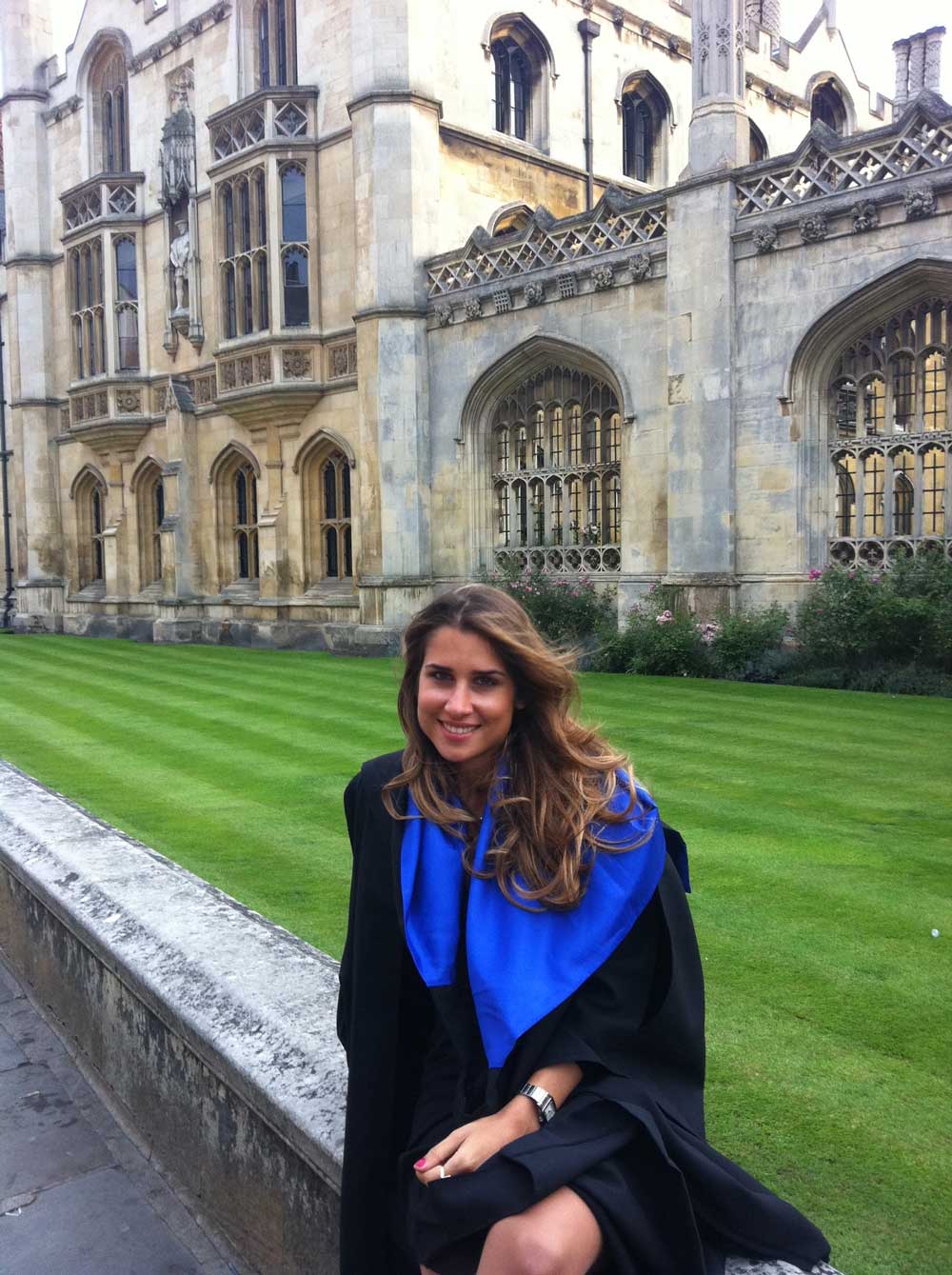
Doctoral graduation, University of Cambridge, 2017.
© 2026 Dr. Irem Gunay. All rights reserved.
